A pumped septic system stores effluent in a chamber and sends it to the field in doses. Floats decide when.
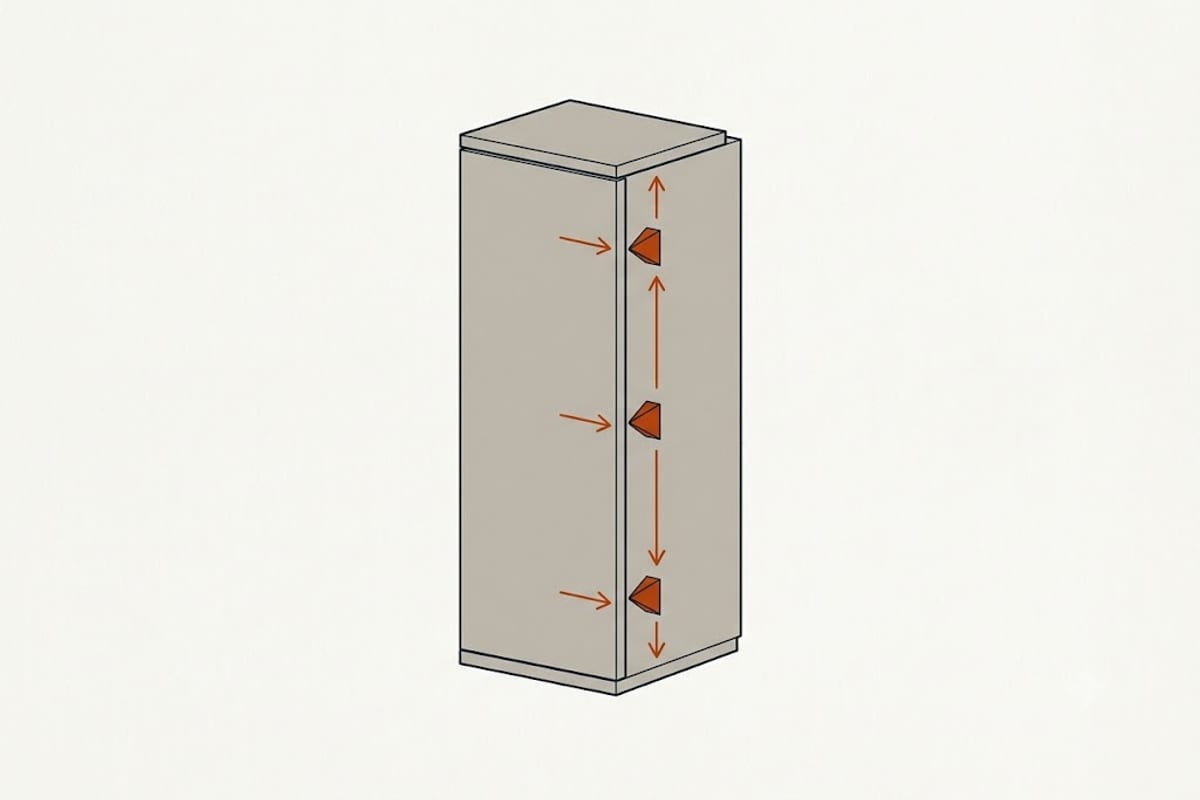
The three floats
Off (low level). The pump stops here, and it must be above the pump intake so the pump never runs dry.
On (high level). The pump starts here. The volume between off and on is the dose volume.
High-water alarm, above the on float. Reaching it means the pump has not kept up, or has failed.
Some systems add a redundant off float, protecting the pump if the primary fails.
Dose volume
The volume between the off and on floats is what goes to the field each time the pump runs.
Too small and the pump short cycles, which wears it out and delivers effluent in dribbles rather than distributing it across the field.
Too large and each dose exceeds what the field can accept at once, pooling at the near end.
On a pressure distribution system the dose is designed to fill the laterals and deliver a calculated volume through the orifices, so the float spacing is part of the design rather than an installer's preference.
Timed dosing
Instead of level control, many systems use a timer: the pump runs for a set period at set intervals, with the floats as backup.
This is better for the field, because it spreads the day's flow evenly rather than delivering it in whatever pattern the household's water use produced. A morning of showers and laundry goes to the field over the whole day rather than in one slug.
Timed dosing is standard on most alternative systems and increasingly used on conventional pumped ones.
The alarm
On its own circuit, separate from the pump. If they share one, a tripped breaker silences the alarm and disables the pump at the same time — which is exactly when a warning is needed.
Audible and visible, mounted where somebody will notice it.
Test it periodically. The test button confirms the alarm works; it does not confirm the float does. Lifting the float is the fuller test and it is a job for the technician at service time.
When it sounds
Reduce water use immediately. The chamber has a reserve above the alarm level, measured in hours of normal use, and less than that under heavy use.
Silence it if there is a silence button — that stops the noise and leaves the light on.
Find out why. Common causes: a tripped breaker, a failed pump, a stuck float, a blocked filter or line, or a field that will not accept the dose.
Do not simply keep silencing it. The reserve is finite and what follows is a backup into the house.
What kills floats
Grease, coating the float so it stops moving freely.
Wipes and rags, tangling the float cords.
Cords not secured properly, so floats drift and change their trigger levels.
Age, since a float switch is a mechanical device in an unpleasant environment.
Floats are inexpensive and they are usually replaced as a set when one fails.
Access and power
The chamber needs a riser to grade with a secure, childproof lid, and a junction box outside the tank rather than in it.
The pump circuit should be its own, with the alarm on another, and both labelled at the panel. During a power cut a pumped system stops working, and the household's usable reserve is whatever the chamber holds — which is worth knowing before an outage rather than during one.
Keeping a spare
Pumps and floats are consumables, and a failure is not something a household can wait a week for.
Keeping a spare pump of the correct model, and a spare set of floats, turns a weekend failure into an afternoon. Both are cheaper bought calmly than urgently.