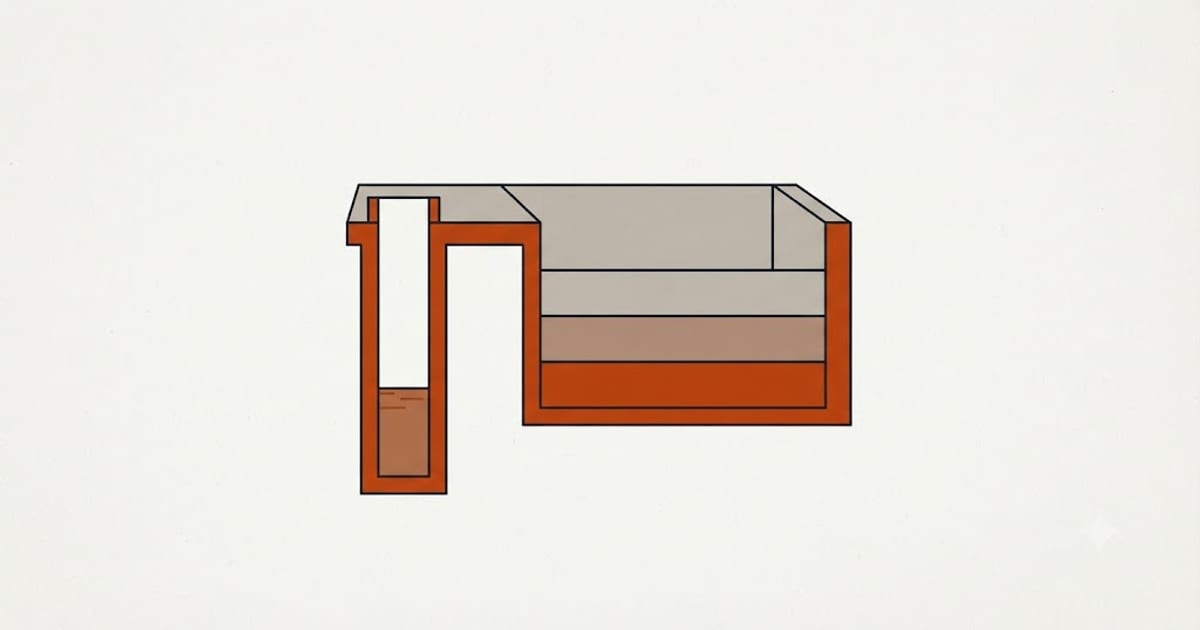
A failed perc test is not one result. It is five different results that all arrive with the same word on the form, and they have completely different consequences. Two of them can be overturned by re-testing. Two of them mean a different system rather than no system. One of them ends the project.
Knowing which one you have is worth more than any advice about what to do next.
The five ways a site fails
| What failed | Can a re-test help? | What it usually means |
|---|---|---|
| Rate too slow (over ~60 min/inch) | Rarely | Clay or a compacted layer — an engineered system |
| Rate too fast (under ~1 min/inch) | No | Coarse sand — needs treatment before native soil |
| Seasonal water table too high | No | Vertical separation cannot be met at that depth |
| Bedrock or hardpan too shallow | No | A mound or fill system, if anything |
| Test conducted badly | Yes | Wrong month, unsoaked hole, disturbed ground |
The last row is the one worth understanding, because it is more common than anybody admits.
Too fast fails too, and almost nobody expects it
Everyone assumes a perc test measures whether water can get away, so faster must be better. It is not. A septic drain field is a treatment device, not a drain. The soil has to hold effluent long enough for bacteria to work on it. Water that disappears in under a minute per inch has passed through untreated, straight toward whatever is below — commonly the aquifer that feeds the well.
Coarse sand fails for the same reason clay fails: it cannot treat. The difference is that clay fails visibly, in your yard, and sand fails invisibly, in somebody's drinking water.
The fix is usually a sand filter or a shallow pressure-dosed system that slows the water down deliberately.
The failures a re-test can overturn
The month. Run a perc test in late August after six dry weeks and the soil takes water it will not take in March. Run it in March, in the same hole, and it can fail outright. This works in both directions, and it is exactly why many counties now specify a wet-season window or require a soil evaluation instead of a percolation test.
The pre-soak. The protocol requires the hole to be pre-soaked, usually for at least four hours and often overnight, so that measurements are taken through wetted soil rather than through dust. A test run dry reads far faster than the site really is — which is a passing failure, and worse than an honest one, because the system gets built.
The hole itself. Augering into moist clay glazes the walls, sealing them like a thumb over the end of a hose. The specification calls for scarifying the sides and removing the smeared material. Skipping it can turn a workable loam into a failed clay.
The location. A test taken across an old driveway, a filled area, or the route the excavator drove during construction measures compaction, not soil. Compacted ground has had the pore structure crushed out of it, and no amount of digging it back up restores it.
If any of these apply, a properly conducted re-test in a different, undisturbed part of the site is a reasonable next step — and far cheaper than an engineered system.
The two numbers a perc test cannot tell you
This is the part that surprises people most: a perfectly acceptable perc rate does not mean the site passes.
Codes require vertical separation — commonly two to four feet of unsaturated soil beneath the bottom of the trench, before groundwater, bedrock, or any restrictive layer. A site with a textbook 20 minutes per inch still fails if the seasonal water table sits eighteen inches down.
Neither of those depths is visible in a percolation hole. They are found in a soil profile pit, dug several feet deep and read by a licensed soil evaluator, who identifies redoximorphic features — the grey and orange mottling that shows where water has stood at some point in the year, even in August when the ground is bone dry.
Many jurisdictions have replaced perc testing with soil evaluation for exactly this reason. The perc test kept approving sites that failed two winters later.
What a failure actually costs you
A conventional trench field is the cheapest thing that will ever be built on that site. Everything past it costs more:
- Mound system — build up above the natural grade to buy separation. Several times a conventional field, plus a pump and its electricity.
- Sand filter — treats effluent before it reaches native soil. Needs annual servicing.
- Aerobic treatment unit — a small package plant. Highest running cost, requires a service contract in most states, and the alarm will eventually go off at an inconvenient hour.
None of these are failures in the sense of being unusable. They are more expensive answers to a harder site, and they need to be priced before land changes hands, not after.
What to do the day the result comes back
- Get the actual numbers, not the verdict. Minutes per inch per hole, the depth each was taken at, the date, and whether a pre-soak was recorded.
- Ask what failed. Rate, separation, or depth to restriction — the three have different remedies.
- Ask whether the site was tested in more than one place. One hole is a data point, not a site.
- If it was a rate failure in a dry month on a disturbed area, ask the county what it would take to re-test. This is the cheapest possible outcome and the one nobody thinks to ask about.
- If it was separation or bedrock, stop optimising the perc test. That result will not change, and the conversation is now about system type and budget.
The single most expensive mistake is treating a failed test as a verdict on the whole property when it was a verdict on one hole, in one month, in ground somebody had driven over.