
Between the tank and the trenches sits a small box whose only job is to divide the flow evenly.
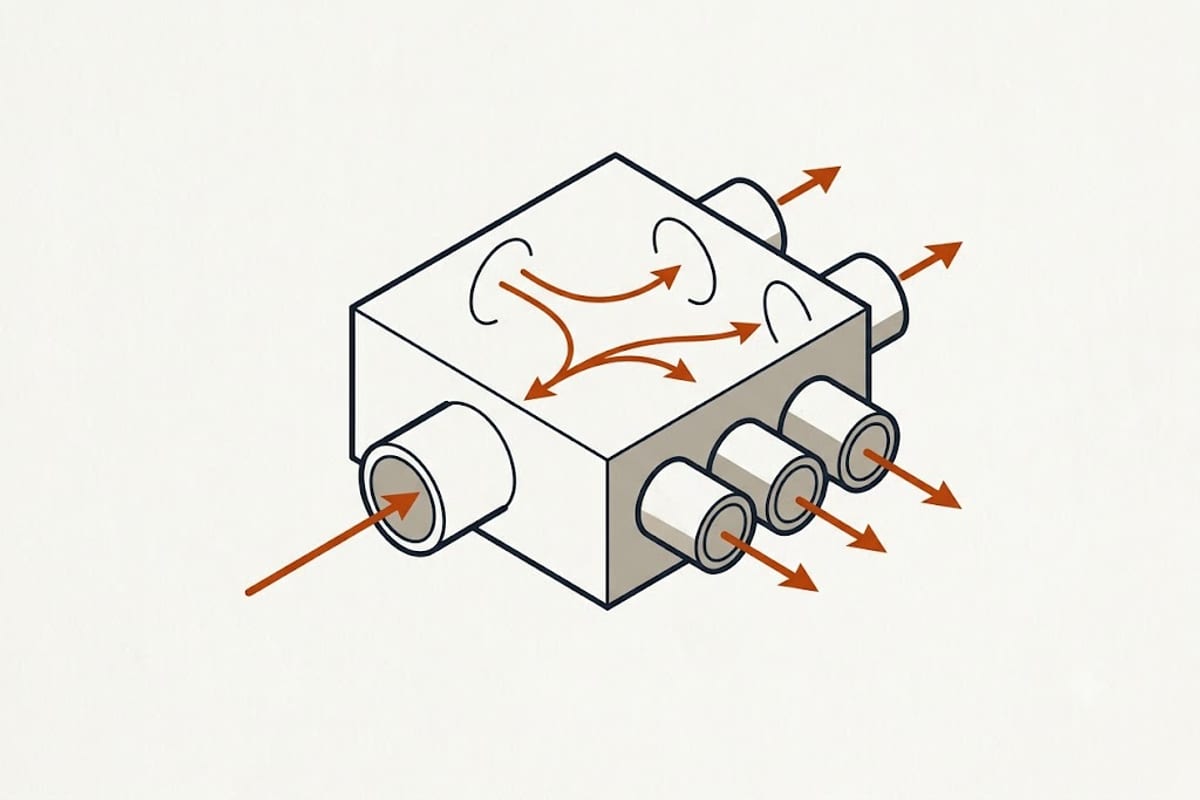
What it does
Effluent enters from the tank and leaves through several outlets, one per trench.
For the field to work as designed, each trench must receive its share. The whole absorption area was calculated on the assumption that it does.
Why it goes wrong
Settlement. The box sits in backfill and the ground moves. A tilt of a fraction of an inch sends most of the flow to the lowest outlet.
Root intrusion, blocking outlets.
Deterioration of an old concrete box.
Solids accumulation, where the tank has been passing them.
A crushed inlet or outlet pipe, from a vehicle above.
What it looks like from the surface
One area of the field wet or lush, and the rest dry.
That is the diagnostic: a failing field usually goes wet everywhere, and a distribution problem goes wet in one place. It is worth distinguishing, because one costs a service call and the other costs a field.
Levelling it
Digging down to the box, cleaning it, and re-levelling it on a stable base.
Flow levellers — small adjustable inserts fitted into the outlets — allow fine adjustment without perfect concrete work, and they let a technician even out the distribution afterwards.
It is inexpensive relative to anything else in a septic system, and it is a repair that can restore capacity to a field that appeared to be failing.
Serial distribution instead
Some systems have no D-box: the trenches are connected in series through drop boxes, so each fills before overflowing to the next.
That is a legitimate design, particularly on sloping ground, and it uses the trenches in sequence rather than together. Drop boxes have their own inspection value — the liquid level in each says how far the field is loaded.
Pressure distribution
A pump and laterals with small orifices, delivering effluent evenly across the whole field regardless of grade.
It removes the levelling problem entirely, costs more, needs power, and is standard on alternative systems and increasingly used on conventional ones on sloping sites.
Inspecting it
The D-box should have an accessible lid, ideally with a riser to grade.
At each pumping, it is worth having the box opened and looked at: is it level, are the outlets clear, is there a solids build-up, and is the flow visibly splitting.
Where there is no riser, fitting one at the next visit makes this a routine check rather than an excavation.
What it cannot fix
A distribution box restores the design, and it does not add capacity.
Where the field is genuinely at the end of its life, or where the household's flow exceeds what was built, levelling the box helps briefly and the underlying problem stands.
The sequence is still: rule out the cheap causes — effluent filter, D-box, crushed pipe, a leaking toilet adding hundreds of gallons a day — before concluding the field has failed. Those four account for a large share of systems that were about to be replaced.
Locating it
The D-box sits between the tank and the field, usually a few feet downstream of the tank, and it is frequently buried with no marker.
The as-built drawing filed with the permit shows it. Failing that, a probe or a transmitter pushed through the outlet pipe finds it — which is a service call rather than an afternoon.
Marking its position once it is found, and fitting a riser, converts a future excavation into a lid.
What a slow-draining house is telling you
Slow drains throughout the house point at the system rather than at one fixture.
The order to check is: the effluent filter first, since it is the cheapest and the most common; then the D-box; then the pipe runs; then the field itself.
Going straight to the assumption that the field has failed is how households end up quoting a replacement for a blocked filter.