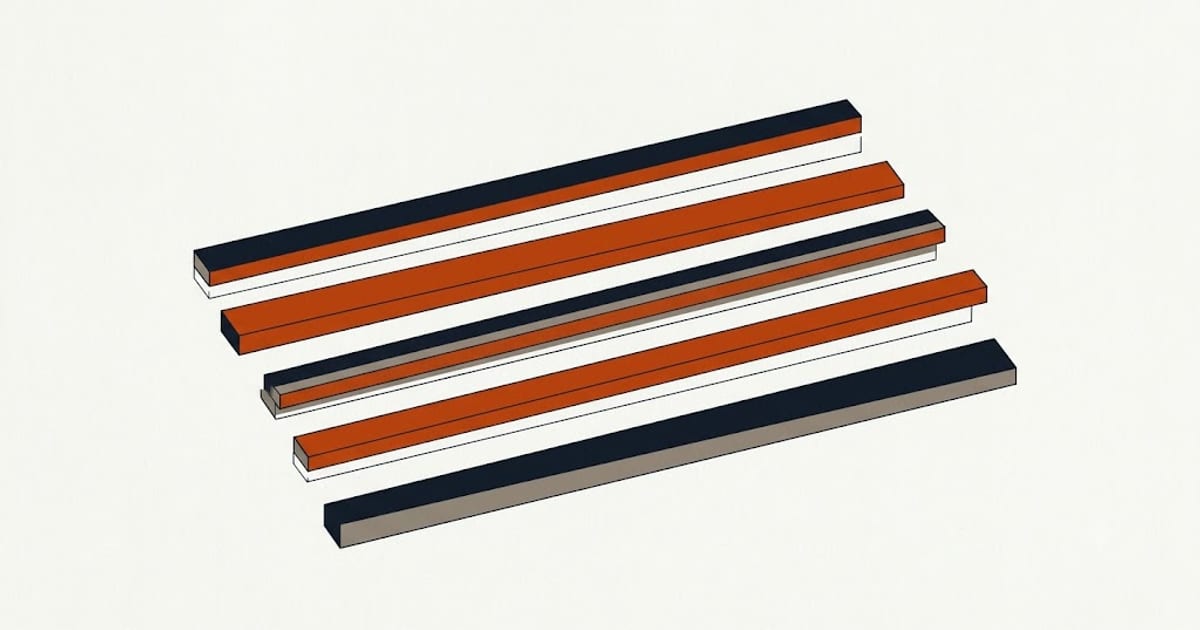
The drainfield — also called the leach field, absorption field or soil absorption system — is where the effluent from the tank is dispersed into the soil and treated.
The calculation
absorption area = design daily flow ÷ application rate
Design daily flow comes from the bedroom count — commonly 100 to 150 gallons per bedroom per day, set by the jurisdiction.
Application rate is how many gallons per square foot per day that soil can accept, tabulated against the perc rate or the soil texture.
A house with a 450 gallon per day design flow on soil rated at 0.5 gallons per square foot per day needs 900 square feet of absorption area.
Why slow soil costs money
The application rate falls as the soil gets slower.
Sandy loam might take 0.8 gallons per square foot per day; a slow clay loam might take 0.2. The same house therefore needs four times the field area on the second site.
That is the whole reason a perc test matters commercially: it sets the size of the most expensive component.
The forms a field takes
Conventional trenches — parallel excavations filled with gravel around a perforated pipe, with the sidewalls and bottom doing the absorbing.
Chamber systems — open-bottom plastic arches instead of gravel. Lighter, faster to install, and in many jurisdictions credited with an area reduction because the open bottom performs better than gravel.
Beds — a single wide excavation rather than trenches. Less sidewall area per square foot, and generally less favoured.
Drip dispersal — small-diameter tubing distributing effluent over a wide area near the surface. Suits difficult sites and needs a pump, filters and periodic flushing.
Trench geometry
Trenches are typically 1 to 3 feet wide, spaced by a specified distance centre to centre so the soil between them is not overloaded, and level along their length so effluent distributes evenly rather than running to one end.
Level is not a detail. A trench with a slope concentrates all the effluent at the low end, which overloads that section and fails it while the rest of the field sits unused.
Vertical separation
The distance between the trench bottom and the seasonal high groundwater or bedrock is what actually treats the effluent, and jurisdictions specify a minimum — commonly two to four feet.
Where that separation does not exist naturally, the answer is a mound system that builds it above grade, at considerably greater cost.
The reserve area
Most jurisdictions require a reserve area — undisturbed ground set aside for a future replacement field.
It must be protected from driving, building, paving and compaction for the life of the property, and its existence is why a lot that could physically hold a house sometimes cannot be permitted for one.
What kills a field
Solids from the tank, which clog the soil interface. An effluent filter and regular pumping prevent it.
Hydraulic overload — more water than the field was sized for, from a leaking toilet, a water softener discharging, or a household larger than the design.
Compaction from vehicles or livestock over the field.
Roots, from trees planted too close.
Age. A biomat forms at the soil interface over time, and eventually a field reaches the end of its life. Thirty years is a reasonable expectation for a well-maintained system.
Serial and parallel distribution
Effluent reaches the trenches either through a distribution box that splits the flow between them, or through a serial arrangement where each trench fills before overflowing to the next.
A distribution box that has settled out of level sends most of the flow to one trench, which overloads it. Levelling a D-box is inexpensive and it is one of the more common findings on an underperforming field.
Pressure distribution, using a pump and small orifices, delivers effluent evenly across the whole field regardless of grade, and it is required on many alternative systems for exactly that reason.